



Imagine walking into a charming boutique where you’re greeted by a friendly member of staff. On a quiet day, this single member of staff can easily serve all the customers. But what happens if a bus full of tourists suddenly pulls up outside and they all want to shop at the same time? This is where the concept of ‘clustering’ comes into play - but instead of shop assistants, we’re talking about servers. In this article, we explain how a web cluster works and why it could be crucial for your online business, particularly if you’re using our Managed Cloud Server solution.
What is a web cluster?
A web cluster is like a team of servers that work together to efficiently distribute and manage the load of web requests (e.g. website visits, transactions). Imagine that each server is a sales assistant in our boutique. Some specialise in sales (web servers), whilst others specialise in managing stock levels (database servers). Another key member of staff is the one who decides which sales assistant serves which customer (load balancer).
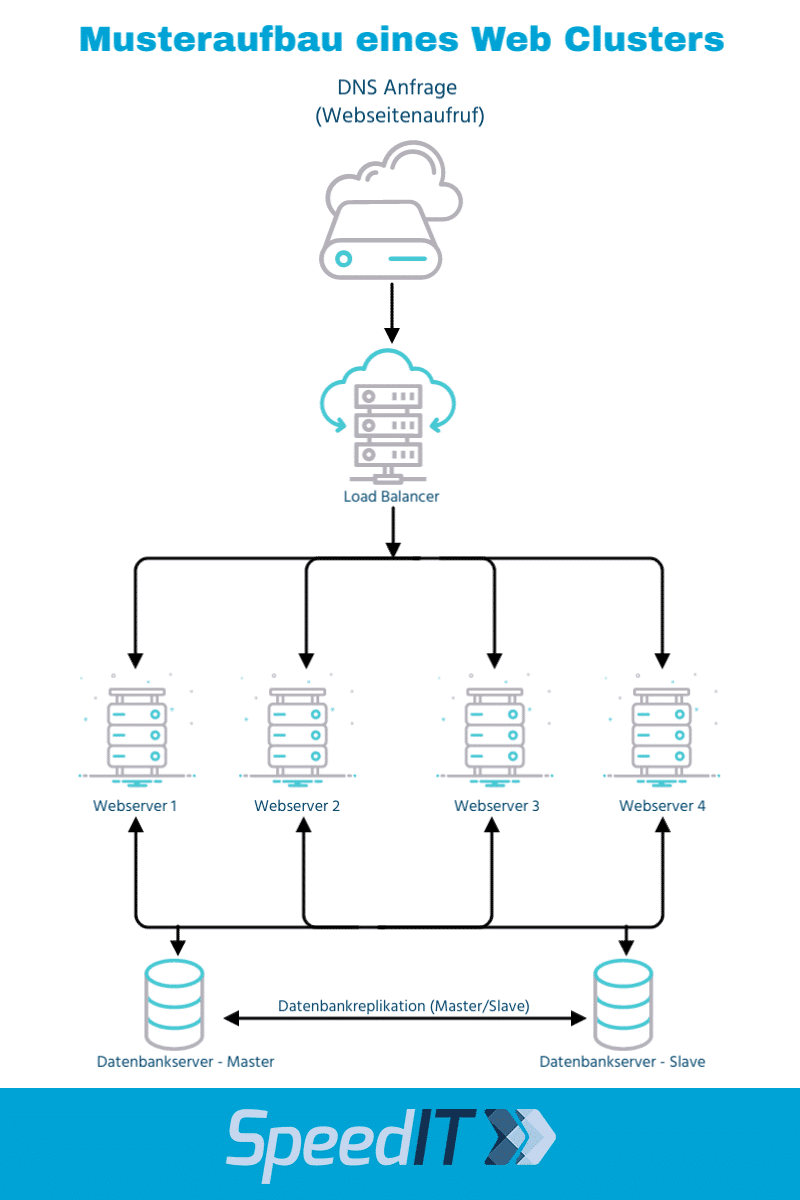
Setting up a web cluster: an example with 7 servers
- 1 load balancer: Decides which requests are forwarded to which web server to ensure an even load distribution.
- 4 web servers: Process requests from website visitors, such as loading web pages or running web applications.
- 2 database servers (MySQL in a master-slave configuration): One server (master) handles write operations and the other (slave) is optimised for read operations to maximise database performance.
Advantages of a web cluster
- Scalability: Just like the extra sales assistants in our boutique, additional servers can be added to the cluster to scale with the website’s growth.
- Availability: If one server (sales assistant) fails, others step in to carry on the work, ensuring your website remains available at all times.
- Performance: Distributing the load across multiple servers ensures there are no delays and the website loads quickly.
Why larger customers need a web cluster
Larger customers with high traffic and transaction volumes need a solution that can keep pace with their business dynamics. A web cluster ensures that their website runs smoothly even during peak traffic times, much like extra staff during a sale in a boutique.
Security and performance through the separation of web and database servers
Separating web and database servers is like dividing sales and stockroom tasks in our boutique. Whilst the web servers focus on serving customers (website visitors), the database servers handle data management in the background. This separation not only ensures optimised performance but also provides an additional layer of security, as sensitive data is isolated and protected.
A prime example of flexibility and security
It is important to emphasise that the 7-server model described here is a prime example illustrating how a web cluster could be configured. In practice, there are numerous ways in which a cluster can be set up to meet the specific requirements and challenges of your online business. For example, master-slave replication in database management can be used not only to optimise read and write operations, but also to serve as a fallback solution. If the master server becomes overloaded or fails, the slave server can step in to prevent downtime and maintain data integrity.
Furthermore, depending on the specific needs of your business and your website, various servers and services can be integrated into your cluster. A central Redis server could, for example, be added to act as in-memory data storage, thereby improving database performance through caching. Similarly, a dedicated mail server could be integrated to manage email traffic efficiently and ensure that important customer communications and notifications are processed reliably.
Configuring a web cluster is a highly customisable process that aims to strike a balance between performance, availability and cost, whilst taking into account the specific requirements and objectives of your online business. With Managed Cloud Servers, we can work together to develop a setup that is precisely tailored to your needs.
Conclusion
A web cluster is like a well-organised team in a boutique, ensuring that every customer is served efficiently, no matter how busy the shop is. With the SpeedIT Managed Cloud Server infrastructure, we can help you create a bespoke cluster setup that supports, protects and scales your online business, no matter how large it becomes.
For further information and personalised advice on our cloud solutions, please feel free to contact us. This blog post serves as a simple explanation of the concept and benefits of a web cluster. We are happy to assist you with detailed technical advice and implementation.