


Our SSL certificate Comparison of quotes
The choice of the right SSL certificate depends largely on your individual requirements. Single-domain certificates are ideal if the focus is on protecting a specific domain. However, if you intend to secure several subdomains under a main domain, a wildcard certificate is the recommended option, depending on the number of subdomains.
- GDPR-compliant
- 100% hosting in Germany
- Personal contact
- Support included
- Provisioning within 24 hours
Single-domain SSL certificates are designed for anyone wishing to secure individual domains. The certificates offer a standard encryption strength of up to 256 bits and come with various NetSure® guarantees.
With single-domain certificates, you can secure one domain at a time - without any associated subdomains (except for www.).
Our Wildcard SSL certificates are ideal for those who wish to secure a main domain and all its associated subdomains. They offer up to 256-bit encryption and comprehensive NetSure® guarantees.
With a wildcard certificate, you can secure your main domain and an unlimited number of subdomains with a single, efficient certificate.
Why do you actually need an SSL certificate?
Trust through security
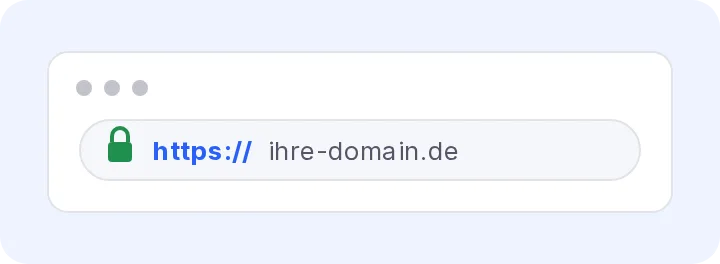
An SSL certificate enables the https:// protocol and is displayed in the browser’s address bar. In addition, the small padlock next to the address bar signals to your website visitors that the website is SSL-protected.
This builds greater trust for both businesses and customers, as visitors know that data transmission is secure.
For some time now, web browsers have been actively issuing warnings when a website without an SSL certificate is visited.
Businesses that offer digital payment options and/or allow users to perform a login with their credentials must comply with PCI security standards (PCI-DSS), which include SSL certification.

Improving SEO rankings
Web security is a top priority. For this reason, it is also a key factor in search engine rankings. An SSL certificate shows the search engine that data transmission between the end device and the server is encrypted.
For this reason, websites with SSL certificates appear higher up in search results than unprotected websites. This can increase organic traffic.
What an SSL certificate does for your website
Nowadays, an SSL certificate is a basic requirement for any professional website. It protects your visitors’ data, builds trust in your brand and is a confirmed ranking factor on Google.
Encrypted data transmission
All data transmitted between the browser and the server is encrypted using up to 256-bit encryption - ensuring that forms, logins and payment details are protected against unauthorised access by third parties.
Data Protection & GDPR
The GDPR requires appropriate technical measures to protect personal data. Encrypted transfer via HTTPS is a must for every contact form and online shop.
Your visitors’ trust
The padlock icon and ‘https://’ in the address bar indicate that your website is secure. Without a certificate, modern browsers actively warn your visitors against visiting the site.
Greater visibility on Google
Google considers HTTPS to be a ranking signal. Encrypted websites are more likely to appear higher up in search results and attract more organic visitors.
Single-domain or wildcard - which certificate is right for you?
Single-domain SSL
Protects exactly one domain, for example your-domain.de, including www.ihre-domain.de.
The right choice for company websites, blogs and individual online shops that can be accessed via a single address.
WildCard SSL
Protects your main domain and any number of single-level subdomains, such as shop., mail. or customers.your-domain.de.
Ideal if you run several services under one domain - one certificate, one term, less administrative effort.
Three steps to a secure website
-
Select a certificate
Based on your domain structure, choose between a single domain and a wildcard.
-
Place an order & confirm your domain
Once you have placed your order, you will be asked to confirm that you are the domain owner. The certificate will then be issued.
-
Install & switch to HTTPS
The certificate will be installed on your server and your website will be redirected to https://. Our support team will be happy to assist you with this.
Frequently Asked Questions
Good to know.
Here we provide answers to the most frequently asked questions about our SSL certificates.
What is an SSL certificate?
An SSL certificate is a digital certificate that verifies the identity of a website and enables an encrypted connection between the browser and the server. It can be recognised by the https:// and the padlock icon in the address bar.
What is the difference between SSL and TLS?
TLS (Transport Layer Security) is the modern successor to SSL (Secure Sockets Layer). Technically speaking, only TLS connections are used nowadays - however, the term ‘SSL certificate’ has remained in common usage and means the same thing.
Why is HTTPS important for SEO?
Google uses HTTPS as a ranking signal. In addition, browsers flag unencrypted pages as ‘not secure’, which deters visitors and increases the bounce rate. Both of these factors affect your visibility in search results.
Single domain or wildcard - which do I need?
If you only use one address, such as your-domain.de, a single-domain certificate will suffice. If you operate several subdomains, such as shop.your-domain.de or mail.your-domain.de, a wildcard certificate is usually the more cost-effective solution.
Does a wildcard certificate also cover deeper subdomains?
A WildCard certificate for *.your-domain.de protects all top-level subdomains, such as shop.your-domain.de. Lower-level subdomains, such as test.shop.your-domain.de, are not included.
Is an SSL certificate mandatory under the GDPR?
The GDPR requires appropriate technical measures to protect personal data. As soon as your website collects data - for example, via a contact form, a login page or an online shop - encrypted transfer is considered state of the art.
What does ‘mixed content’ mean?
The term ‘mixed content’ refers to a situation where an HTTPS page still loads individual elements, such as images or scripts, via http://. Browsers block this content or display a warning. Following the migration, all internal links should therefore be updated to https://.
What does the NetSure® guarantee mean?
The NetSure® guarantee is a form of protection provided by the issuer of the certification authority in the event that damage is caused by an error made when issuing the certificate. The amount of the guarantee varies depending on the certificate.
Awards & Partnerships





Agency partners
Professional support for agencies.
-
Initial call
Personal, about your goals and clients.
-
Partnership
Simple contract, dedicated contacts.
-
Training & support
Your team knows every detail.